- The problem
- Case software spreads a matter across separate tabs: parties in one, money in another, deadlines and billing somewhere else. Answering "what's going on with this person?" means opening all of them.
- What I built
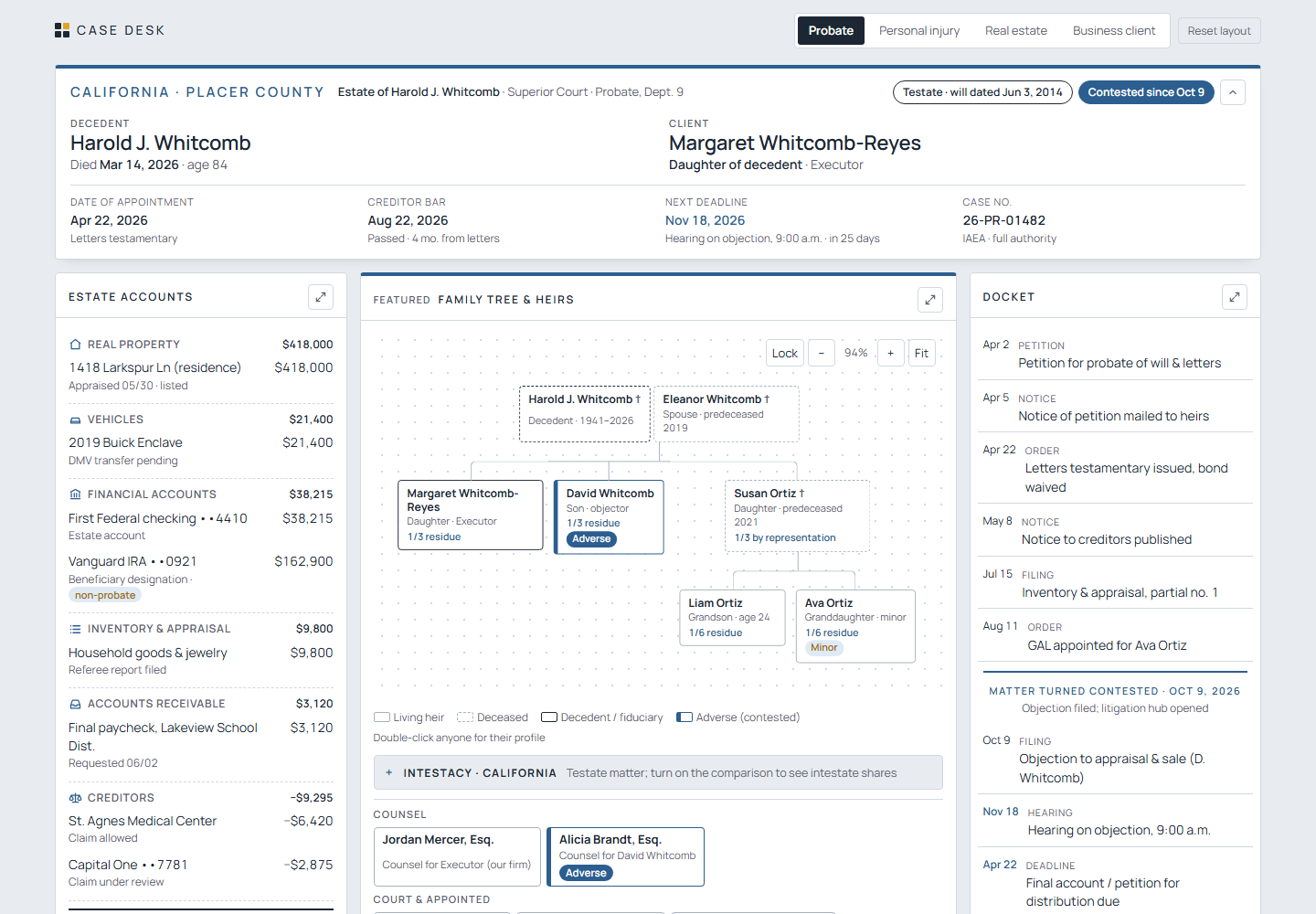
- A working prototype of a matter workspace.
- Tiles for accounts, a family tree or stakeholder map, the docket, communications, calendar and billing
- Select anyone and every account, filing, email, task and time entry tied to them is highlighted
- The featured tile changes shape by industry: a family tree for probate, a treatment chain for injury, a deal pipeline for real estate
What I do
Three ways I make hard work manageable
Systems & operations
Make the whole caseload visible and keep it moving.
- Dashboards and automated flags
- Workflow and template design
- System setup and data migration
- SOPs people actually use
Custom tools
Software shaped around how the work is really done, built with AI-assisted development.
- Rules engines and calculators
- Document assembly
- Safe, practical AI workflows
- Replacing tools a team has outgrown
Complex financial work
Records that tie out, in the format the reader needs.
- Fiduciary accountings and inventories
- Reconciliations and cleanups
- Reconstructing incomplete records
- Client-ready schedules and summaries
Selected work
Built from inside the work
Each of these started as a real problem on a real caseload. Every example uses fictional people and figures.
- The problem
- AI models write useful first drafts, but pasting a document into one exposes names, dates and account numbers that should never leave the office. Meanwhile, the firm's best filings sit in old matter folders, and reusing one means hunting down every name and date by hand.
- What I built
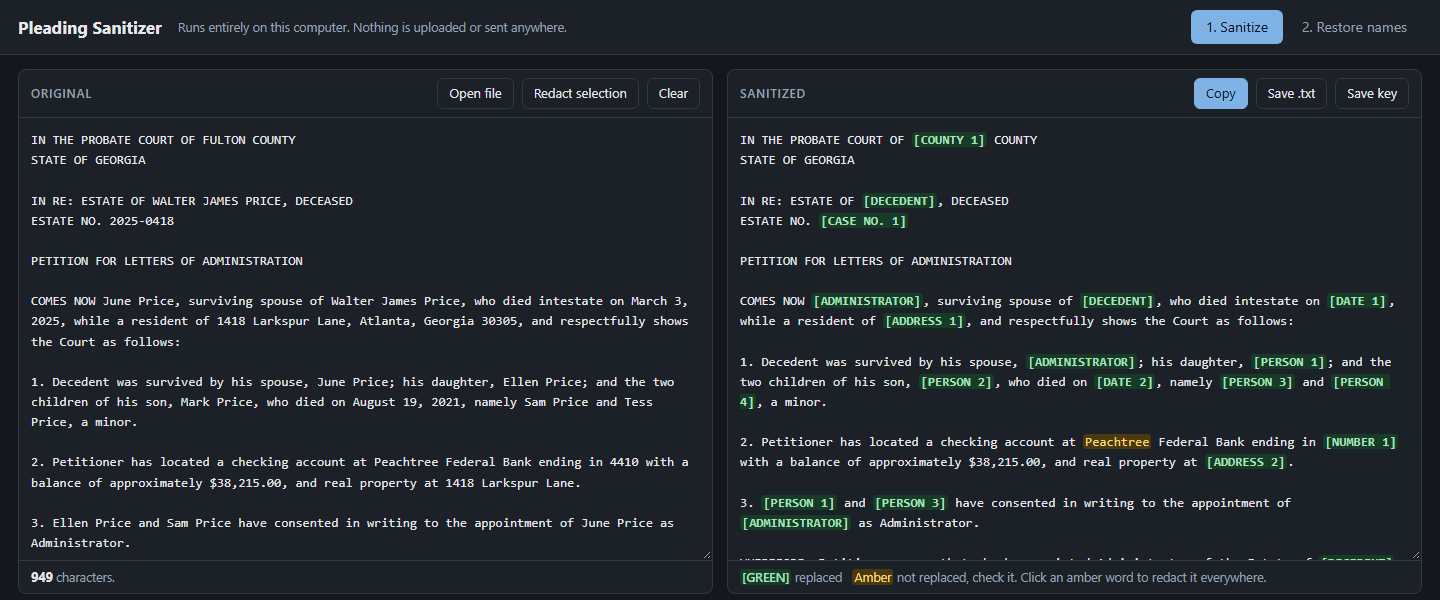
- A browser tool that runs entirely on the user's computer. It opens Word, PDF or text files, swaps names, dates and identifiers for consistent placeholders like
[DECEDENT]and[DATE 2], and highlights anything it is unsure of for a person to check.- Safe AI drafting: send the placeholder version to an AI model, then restore the real values in one click when the draft comes back
- Template starter: the placeholder version is already a template. Any filing that worked well becomes a reusable starting point for the next matter, with the fill-in fields marked
- The result
- Nothing is uploaded anywhere. Staff get the speed of AI drafting while client data stays on the machine, and a firm's best work turns into its template library as it goes.
- The problem
- Checking an AI transcript against the audio meant juggling windows, retyping the same formatting fixes, and having no real measure of how long a job took.
- What I built
-
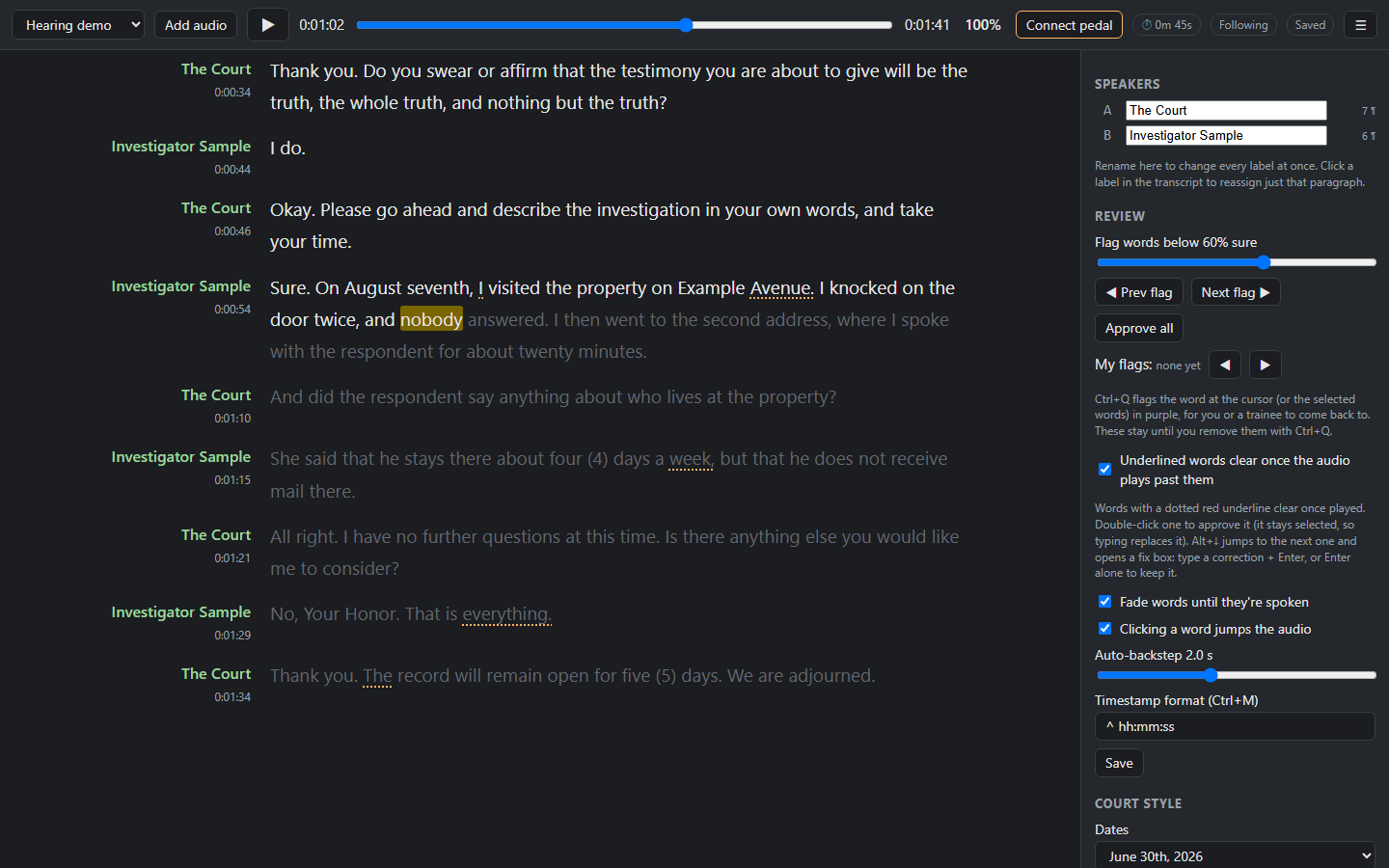
- AI first draft with speaker labels, about $0.33 for a 90-minute hearing
- Click any word to jump the audio there; words the model was unsure of are underlined for review
- Court style applied automatically ("four (4) days", consistent dates and times) and export to court format
- Deletes the vendor's copy of the audio and transcript once saved locally
- The result
- A built-in "X factor" metric (hours worked per audio hour) that counts only audio actually reviewed, so turnaround is measured instead of guessed.
- The problem
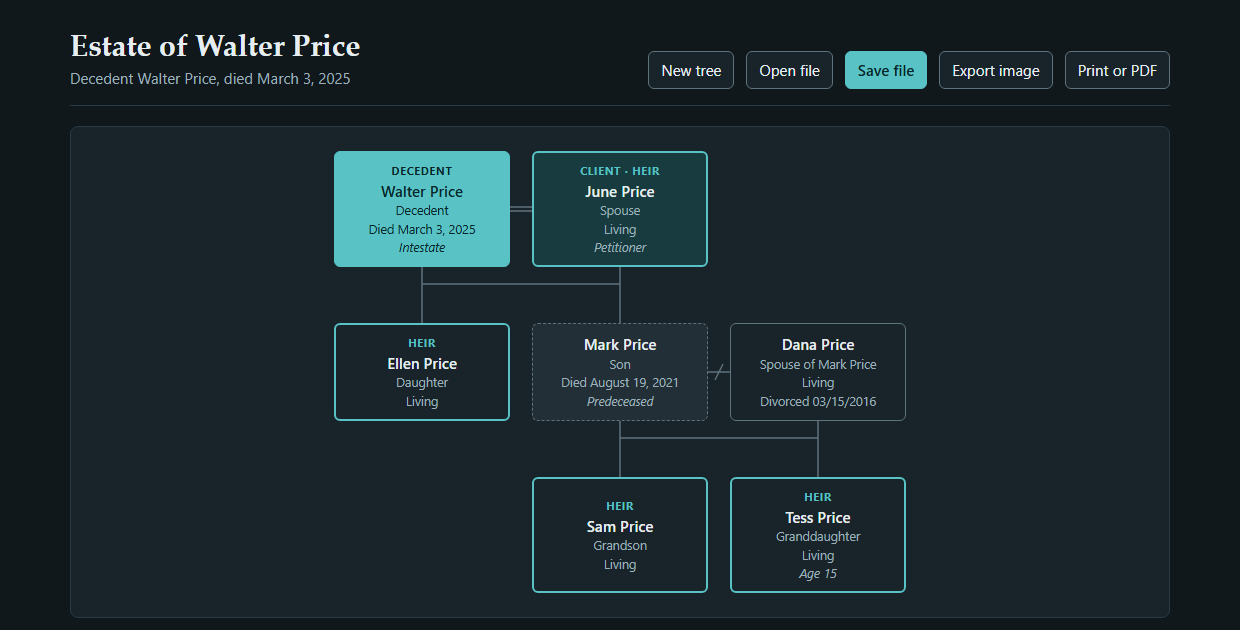
- Working out who inherits meant redrawing the family tree and redoing the math every time a fact changed: a predeceased child, a disclaimer, an adoption, a second marriage. Each state answers those questions differently.
- What I built
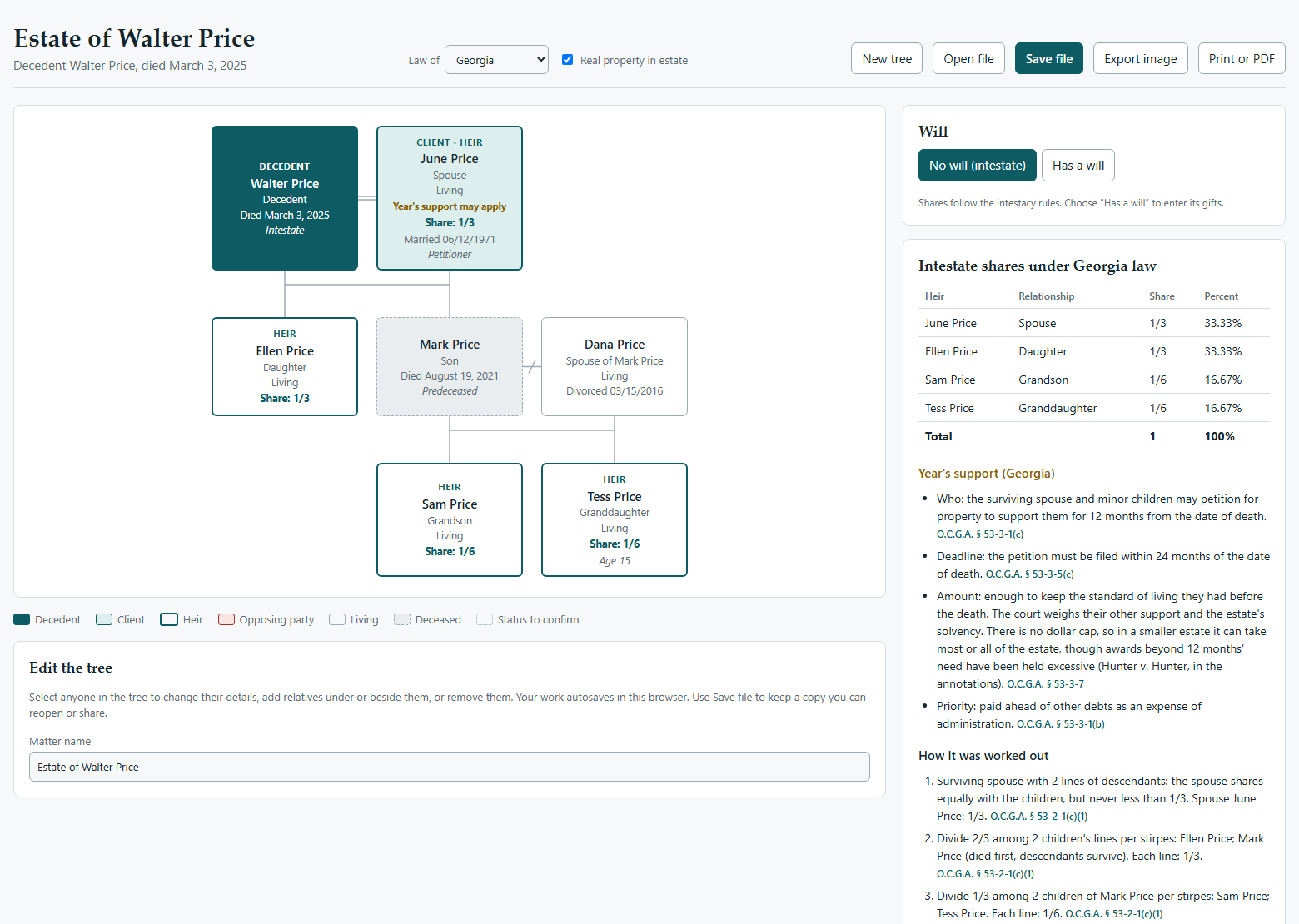
- A visual family-tree editor with a share engine for North Carolina, South Carolina, Georgia and Tennessee.
- Handles wills and intestacy, multiple marriages, divorce, adoption, disclaimers and minors
- Computes exact fractions, never rounded decimals, and explains each step with its statute
- Flags facts that still need confirming; exports a clean tree for the file
- The result
- The tree and the share table update together the moment a fact changes, so the attorney reviews a finished draft instead of a sketch.
- The problem
- A caseload of 80 to 100 active contested matters (160 at peak) lived across separate team boards. A stalled file usually surfaced when the client called to ask why.
- What I built
- A master dashboard that pulls seven workstream boards into one view, with time-decay rules that flag and consolidate every matter untouched in the prior 30 days so work can be rebalanced before it slips.
- The result
- One board showed every active matter, and anything untouched for 30 days surfaced on its own instead of waiting for a client call. Milestone dashboards tracked 300+ case activities a week.
- The problem
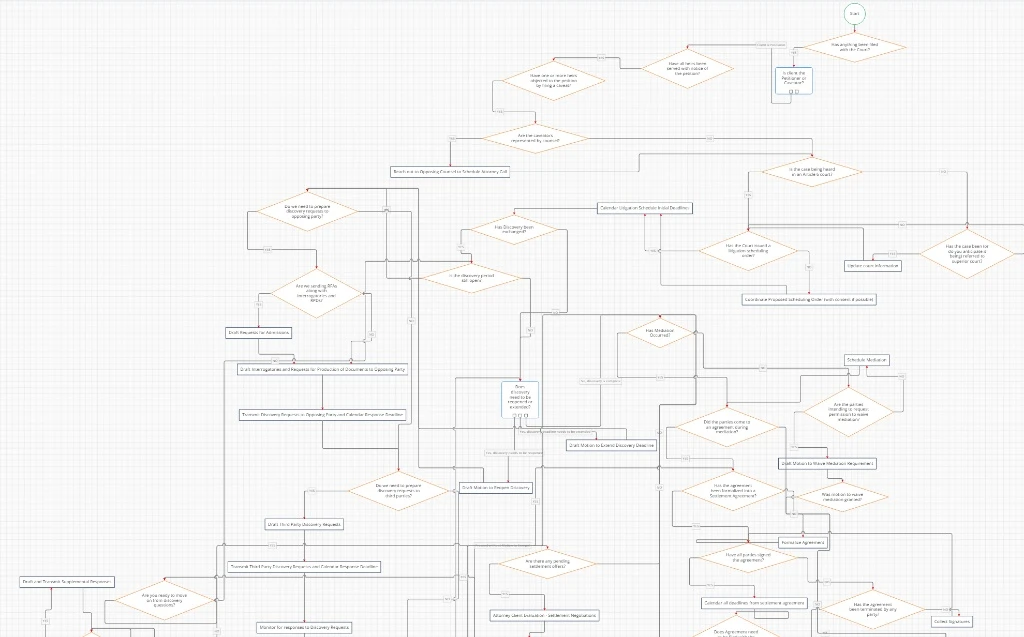
- Litigation rarely starts at step one. Matters arrive mid-dispute, after discovery has opened or a scheduling order has issued, and a straight checklist makes staff click through dozens of tasks that no longer apply.
- What I built
- A decision-driven workflow for a contested matter, from first filing through appeal.
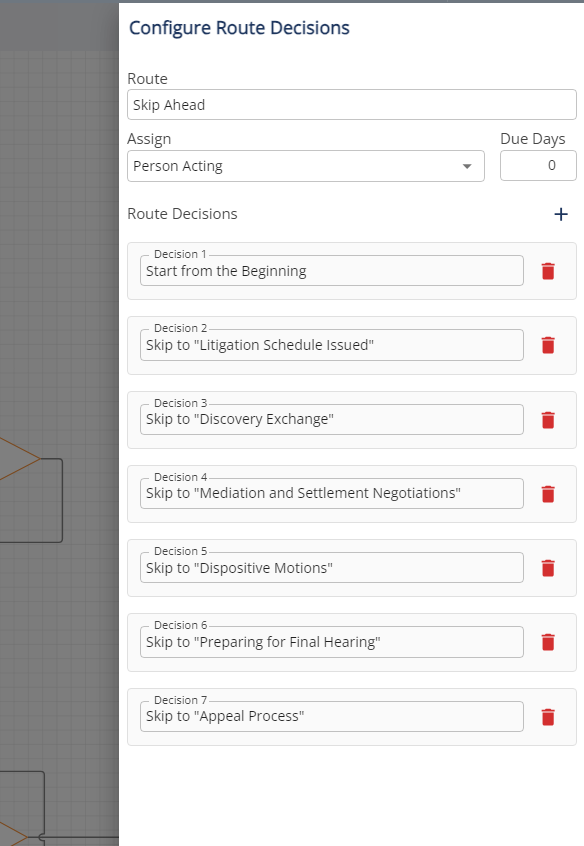
- Skip Ahead: one route at the start drops a matter in at any of seven stages, from the beginning through scheduling, discovery, mediation and settlement, dispositive motions, final hearing, or appeal
- Every branch is a yes-or-no question (Have all heirs been served? Is the other side represented? Was the motion to waive mediation granted?) that routes to the next drafting, calendaring or monitoring task
- Practice judgment built in: whether the case is headed to superior court, and when an appeal calls for a new engagement
- Still growing, with new branches added as real matters expose them
- The result
- Staff land on the right task for where the case stands, and the questions double as training for newer paralegals.
- What I built
-
- A 44,000-word SOP manual from intake through closing, with a decision tree for 13 standard-form petition types, cross-state referral procedures and county-by-county variations
- A 22,000-word paralegal field guide: what to do, and when to escalate, in more than a hundred real situations, from a missed deadline to a client who admits taking estate property
- A structured initial-call form so every intake captures the same facts, assets, deadlines and action items
- 30+ task templates and 7 automated workflows for routing, task sequences and document generation: flat-fee uncontested estates and guardianships in Georgia, uncontested estates and guardianships in North and South Carolina, and contested estates and guardianships
- Migration of 100+ matters from Google Sheets to Excel and SharePoint with full data integrity
- SharePoint and Excel case trackers driven by Office Scripts and Power Automate: automatic archiving, revenue sync, milestone aging flags, KPI reporting, and a hold on downstream work until payment clears
- A multi-state filing structure and naming convention, with training videos so team leads adopt it consistently
- A tiered fee schedule and a rebuilt engagement agreement
- The result
- The fee schedule, engagement agreement and operations audit were each adopted by firm leadership.
- The problem
- Estate inventories and accountings were retyped into each state's court forms by hand, and a total that balanced was treated as correct. A newly appointed personal representative, meanwhile, got a stack of papers and little idea what they now owed the court.
- What I built
-
- North Carolina: a 17-tab workbook mapped line by line to the AOC inventory and account forms, with schedules A through H, a cash ledger, sales gains and losses, distributions, and a statutory commission ceiling
- Integrity checks that compare inventory, sales, ledger and bank balances and flag anything unaccounted for, plus inventory, creditor and annual-account deadlines calculated from the statute
- South Carolina: a workbook mapped to the 350ES inventory and 361ES accounting forms, with a guide to where the form's math catches people and the inventory due date calculated
- Georgia: a matching workbook for Georgia's filings; the same pattern rebuilds for any state's forms
- A post-appointment letter and packet that walks the representative through duties, deadlines and forms, in versions for several states
- The result
- Case details are entered once and every schedule fills from them. Accountings arrive in the court's own format with the reconciliation already proven, and the client has a written record of what they were told.
Creative project
A cover letter, filed as a motion
An exercise in format: a cover letter written the way a legal team reads, with a caption, numbered grounds and a prayer for relief.
- Each numbered ground answers something the posting asked for
- The tools on this page appear as supporting facts, one sentence each
- The prayer for relief makes a clear, specific ask
Division of Remote Operations
Movant,
v.
Your Company,
Respondent.
RE: LEGAL OPERATIONS OPPORTUNITY
NOW COMES Movant, RACHEL HALE ("Movant"), pro se, and respectfully submits this Motion for Employment Consideration to YOUR COMPANY ("Respondent"). In support thereof, Movant shows as follows:
- Professional Role and Ethical Boundaries. Movant is a Senior Litigation Paralegal and Legal Operations Specialist, not an attorney, and works within attorney supervision and professional conduct standards. Movant has deliberately built a career around the procedural, operational and financial infrastructure that lets attorneys practice at their best.
- Alignment with Skills Sought. Respondent seeks a systems-focused specialist who maintains governance, manages compliance, and scales operations without friction.
Read the full motion
- Environmental Considerations. Movant thrives in high-autonomy environments where legal operations serve business objectives and manual bottlenecks give way to reliable, repeatable workflows.
- Background and Experience. Movant pairs a Bachelor of Science in Accounting with workflow engineering. Rather than adding software subscriptions, Movant designs the solution:
a. Interactive Matter Intake & Kinship Canvas, which replaces static questionnaires with a live map of parties, vital statuses and adverse interests;
b. Multi-Jurisdiction Estate Allocation Engine, which models testate gifts alongside statutory per stirpes splits, producing fractional and percentage shares for attorney review;
c. PII Sanitizer, a client-side utility that converts sensitive identifiers into placeholders and restores them from a reversible key; and
d. Operational Standards, including a comprehensive SOP manual, a paralegal field guide, and standardized multi-state matter taxonomies. - Litigation, Fiduciary Accounting and Risk. Movant brings more than four (4) years of litigation, court accounting and legal administration across Georgia, North Carolina and South Carolina, and analyzes statutes, procedural rules and financial records to trace assets and reconcile disputed ledgers to the penny.
- Scope Discipline and Stakeholder Rapport. Movant de-escalates tense inquiries, holds operational boundaries, manages budgets and vendors, and spots operational vulnerabilities before they become docket exposure.
WHEREFORE, Movant respectfully prays that Respondent: (a) grant this Motion and consider Movant for Senior Legal Operations, Corporate Governance, Fiduciary Claims or Systems Architecture roles; (b) schedule an initial consultation to evaluate mutual alignment; and (c) grant equitable consideration regarding compensation commensurate with skill and experience.
/s/ Rachel Hale
Movant, pro se
More work
Smaller builds
Document assembly
PythonGenerates recurring pleadings and legal packets from matter data, so routine filings start as finished drafts.
My year in time
DashboardA "Wrapped"-style review built from a full year of my own time entries, sorting substantive work from routine to show where the hours went. It's where the 74% billable utilization figure comes from.
Petition decision tree
ReferenceGuides a paralegal to the right standard-form petition from a few questions about the estate.
Transcription speed suite
AutoHotkeyScripts, text expansion and Word style templates that raised production speed by 50% across 900+ legal transcripts.
Background
Accountant, paralegal, builder
I came to operations through the books. Reconciling accounts for small businesses taught me to distrust numbers until they tie out; contested probate taught me what happens when they don't. I build with Python, Excel, monday.com, LEAP and Claude Code, and I write the SOPs so the tools outlast me.
Practice & case management
Finance & accounting
Automation & AI
Documents & collaboration
Credentials
- B.S. Accounting (Auditing) · Purdue Global, 2024
- CJIS Security Awareness, Level 2 · cleared vendor for law enforcement agencies
- QuickBooks Online ProAdvisor · certified 2022
- 2026 – nowSenior Litigation Paralegal, Legal OperationsMulti-state probate practice · GA, SC, NC
- 2022 – 2026Senior Paralegal, Client Success & OperationsContested probate and fiduciary litigation firm · Georgia
- 2018 – 2022Full-Charge BookkeeperCPA firm · Florida · 60+ small-business clients
- 2014 – nowIndependent Legal Transcriptionist900+ legal and investigative transcripts for clients in Minnesota, California, New York, the UK and China, and government agencies nationwide. One long-standing client today.
- 2024B.S. Accounting (Auditing)Purdue Global University · completed while working full-time